Jobs in Germany at a Factory: Salary, Documents, Housing and How to Find a Vacancy
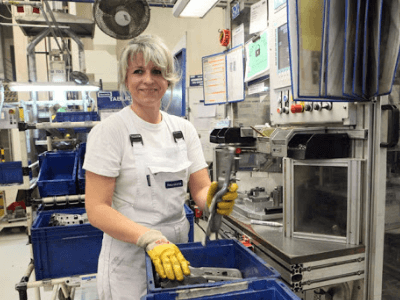
A job in Germany at a factory is one of the most common searches among people planning to move to Europe for a stable income. Germany remains the largest industrial economy in the European Union, and factories constantly need packers, assemblers, line operators, order pickers and warehouse staff. This article covers how much factories actually pay, which documents are accepted for employment, whether German language or experience is required, what housing and shift conditions employers offer, and how to tell a genuine vacancy from a fraudulent one.
If you are still choosing a country, a general overview of opportunities is available in Work in Europe, while this article focuses specifically on German factories and manufacturing plants.
How much factories in Germany pay
Since 1 January 2026, the statutory minimum wage in Germany is 13.90 euros gross per hour, rising to 14.60 euros per hour from 1 January 2027. For a full-time 40-hour week, that corresponds to roughly 2,409 euros gross per month. This is only the legal floor: an actual factory vacancy can pay more, especially with shift, night and overtime supplements.
Job aggregators regularly list factory and warehouse positions in the range of 2,200–2,800 euros per month, or 13–16 euros gross per hour, depending on the industry, shift and region. Some employers advertise a starting rate of 14.96 euros per hour rising to 15.33 euros per hour after the probation period, plus holiday pay and a Christmas bonus.
It always matters whether a figure is gross (before tax and social security contributions) or net (take-home pay). The net amount is usually noticeably lower than the gross rate, so for budgeting it is best to ask the employer for the net monthly figure directly.
Table 1. Salary by type of factory job
| Position | Pay format | What to clarify |
| Packer | €/hour or €/month | net or gross, output quotas |
| Assembler | €/hour | experience, line type, shift pattern |
| Order picker | €/hour | quotas, warehouse, pallet handling |
| CNC operator | €/hour or €/month | qualification, language, experience |
| Warehouse worker | €/hour | physical workload, transport to the site |
| Car plant worker | €/month | brand, duties, documents |
Which documents are needed to work at a factory in Germany
The simplest route is an EU passport — EU citizens can work in Germany without an additional work permit. A German residence permit with the right to work is also suitable, but the exact conditions should be confirmed individually.
Some listings mention a Polish residence card and a Polish work visa — a common arrangement when a worker is formally hired by a Polish company that posts them to a factory in Germany. For Ukrainian citizens, Section 24 temporary protection status together with a PESEL UKR number is frequently listed as acceptable. For Belarusian citizens, employment usually goes through a work visa or dedicated programmes; a detailed breakdown is available in Jobs in Germany for Belarusians.
It is worth checking separately whether a German employment contract is signed directly or whether the work is arranged through a staffing agency or contractor. A full breakdown of legal employment schemes and document requirements is collected in Legal Work in Germany.
Table 2. Documents for working in Germany
| Document | Is it accepted | Comment |
| EU passport | usually accepted | the simplest employment route |
| Residence permit with right to work | depends on conditions | should be confirmed with the employer |
| Polish residence card | appears in listings | common when hired through Polish companies |
| Polish work visa | appears in vacancies | common when working through an intermediary |
| PESEL UKR | appears in listings | relevant for Ukrainian citizens |
| Section 24 | often listed | for people displaced from Ukraine |
Do you need German and prior experience
Most entry-level factory jobs — packing, sorting, simple assembly, warehouse work — do not require experience or German. Employers train new staff on site, and in international teams basic English or Russian is often enough to communicate with a supervisor.
German becomes important for more skilled roles such as CNC operator, mechanic or maintenance technician, where relevant experience or willingness to train before starting on the line is also usually required. If you are considering simple jobs not only in Germany but across Europe, Easy Jobs in Europe is a useful overview.
Housing, shifts and working conditions at a factory
Factory schedules are usually full-time: 8, 10 or 12-hour shifts, Monday to Friday or Monday to Saturday, with day and night shifts. Night and overtime hours are typically paid with a supplement.
Housing is often provided by the employer or a staffing agency, either free of charge or with an amount deducted from the salary. A room is usually shared by one to three people, and separate rooms are often available for couples. Transport to the factory is sometimes organised by the employer, while in other cases employees arrange it themselves.
Table 3. Housing conditions
| Parameter | What to clarify |
| Housing provided | yes or no |
| Cost | free or a monthly amount |
| Deduction | from salary or paid separately |
| People per room | 1–3, separate rooms for couples |
| Distance to work | walking distance or by transport |
| Transport | free or paid |
Which vacancies and industries are available at German factories
The most common positions include packer, assembler, order picker, sorter, CNC operator, mechanic, lathe operator, seamstress and warehouse clerk. Work is available at car plants (including production lines for brands such as BMW, Mercedes-Benz and Volkswagen), in food production (chocolate, tea, coffee), at tyre and cosmetics manufacturers, tobacco factories, and large warehouses run by online retailers and supermarket chains.
Some vacancies suit both men and women, while others are specifically designed for couples with housing for two provided. Age limits on some positions go up to 45–60 years, which should be checked in the specific listing.
Which German cities have the most factory vacancies
Most offers are concentrated in industrial regions and major cities: Berlin, Hamburg, Frankfurt, Cologne, Dresden, Dusseldorf, Munich, Stuttgart and Bremen. Large car manufacturing and logistics companies operate in these cities, so recruitment runs almost continuously.
If you are comparing not only German cities but other EU countries as well, it is worth checking Which European Country Is Easiest to Get a Job beforehand.
How to check a vacancy and avoid scams
Before applying, it is worth checking a few basic points: whether the salary is stated gross or net, who the employer actually is — a direct company or an intermediary, what language the contract is in, how much housing costs and what is included in that price, how recent the listing is, and whether there are reviews about the employer. Legitimate vacancies never require payment for employment and always provide a direct contact.
Table 4. Checking a vacancy
| Criterion | What to check |
| Salary | gross or net |
| Employer | direct or intermediary |
| Contract | German, Polish, through an agency |
| Housing | cost and conditions |
| Schedule | hours, shifts, overtime |
| Relevance | publication date of the listing |
How to search for a factory job in Germany on mastermap.pl
mastermap.pl is a job search built around a map of Europe. Next to vacancies on the map, the site shows services that make it easier to relocate to a new city or country: housing close to the workplace, local language courses, legal services and legalisation assistance.
Vacancies on the mastermap.pl map can be filtered by specific conditions: with housing provided, for women, for men, and urgent vacancies where the paperwork is processed as fast as possible. You can also type a specific job title into the search and see in which country or city that position is currently open.
The site shows both vacancies and relocation services at the same time, and the user contacts the recruiter directly — the platform itself does not charge for using it.
Frequently asked questions about factory jobs in Germany
How much do factories pay in Germany?
In 2026 the statutory minimum is 13.90 euros gross per hour, and real factory offers usually fall between 13–16 euros per hour or 2,200–2,800 euros per month, depending on the industry and shift.
Is the salary shown gross or net?
Listings most often show the gross rate, meaning the amount before tax and social security deductions. The exact take-home amount should be confirmed with the employer separately.
Is there extra pay for night shifts and overtime?
Yes, night, weekend and overtime hours at most factories are paid with a supplement, and the exact amount is specified in the individual vacancy.
Do employers pay bonuses?
Some employers pay holiday pay (Urlaubsgeld) and a Christmas bonus (Weihnachtsgeld), as well as bonuses for meeting output quotas.
Can I work with an EU passport?
Yes, EU citizens do not need an additional work permit to take a factory job in Germany.
Is a Polish work visa or residence card accepted?
Yes, this arrangement is common in listings where employment is arranged through a Polish company that posts the worker to a factory in Germany.
Can I get a job under Section 24?
Yes, for Ukrainian citizens under temporary protection, Section 24 status together with a PESEL UKR number is frequently listed as an accepted document.
Can I work without knowing German?
Yes, entry-level positions such as packing, sorting and simple assembly usually do not require German, and training is provided on site.
Can I get hired without experience?
Yes, a large share of factory and warehouse vacancies are open to candidates without experience, especially in packing, sorting and warehouse roles.
Is housing provided?
In many vacancies, housing is provided by the employer or a staffing agency, either free of charge or with an amount deducted from the salary — this should be confirmed in the specific listing.
Are separate rooms available for couples?
Yes, some vacancies are designed for couples and include a separate room for two.
Is transport to work provided?
In some vacancies transport to the factory is arranged by the employer, while in others employees get there themselves — this is stated in the conditions of each listing.
What shift patterns are used at factories?
Shifts are usually 8, 10 or 12 hours, the schedule can include day and night shifts, and the working week typically runs Monday to Friday or Monday to Saturday.
Which German cities offer the most vacancies?
Most offers are found in Berlin, Hamburg, Frankfurt, Cologne, Dresden, Dusseldorf, Munich, Stuttgart and Bremen.
Is the work suitable for women?
Yes, a large share of factory vacancies — packing, sorting, quality control — is open to both women and men.
How can I tell a vacancy is not a scam?
Check whether the salary is gross or net, who the employer is, whether there is an official contract, whether the listing is current, and whether any upfront payment is requested for employment.
How quickly can I start working?
Some vacancies are marked urgent, with faster paperwork processing — such offers can be found using the corresponding filter on the vacancy map.
Conclusion
A factory job in Germany in 2026 remains a realistic and accessible option for candidates with different levels of experience, language skills and documents. Instead of comparing scattered listings one by one, it is more convenient to browse vacancies on a map together with housing, language and legalisation services — making it easier to decide and plan the move.
Comments 0
All comments are published after review.
No comments yet. Be the first!